Play This Emotional Recognition Game for Elementary Students: Build-a-Moji


Build-a-Moji: Strengthening Emotional Recognition Skills
Help students identify and understand emotions by exploring facial expressions, labeling feelings, and discussing how emotions appear in different situations with this interactive game.
Interpreting facial expressions isn’t always intuitive. Students benefit from structured opportunities to observe, reflect on, and connect facial cues to a range of possible emotions.
Build-a-Moji focuses on constructing facial expressions, helping students understand how specific features contribute to different emotions. While many students can name basic feelings, they may struggle to identify subtle differences between expressions or explain what a particular expression is communicating.
Emotion identification plays an important role in communication and self-awareness. When students can accurately read facial cues, they are better prepared to respond appropriately during peer interactions and classroom discussions.
This skill does not develop through reminders alone. Students benefit from structured opportunities to look closely at facial features, discuss what they notice, and connect expressions to emotion vocabulary.
Hands-on activities can make emotional recognition more concrete. When students actively build and analyze facial expressions, they begin strengthening their understanding in a way that feels engaging and purposeful.
In this post, we will explore what emotional recognition looks like for elementary students, how to help learners practice identifying emotions, and how an emotional recognition game can support this instruction in an engaging format.
What Does Emotion Recognition Look Like for Students?
Emotion recognition involves noticing specific facial cues and understanding how those features signal different feelings. Students look at what Everyday Speech calls the Big Three – eyes, eyebrows, and mouth – to determine what emotion may be represented.
In the classroom, this might include recognizing when a peer looks frustrated during group work or noticing when someone appears excited about sharing an idea. Strong emotion recognition allows students to respond more thoughtfully and adjust their behavior when needed.
This skill also includes explaining why a particular expression represents a certain feeling. When students can describe how raised eyebrows or a frown connect to an emotion, they deepen their understanding beyond simple labeling.
With repeated practice, students become more confident in identifying emotions and using accurate vocabulary to describe what they see.
How to Help Students Practice Identifying Emotions
Effective instruction focuses attention on key facial cues. Educators can guide students to examine the eyes, eyebrows, and mouth and discuss how small changes affect the emotion being shown.
Guided prompts support deeper thinking. Asking students why a face looks surprised or disappointed encourages them to connect visual cues to emotion words.
Structured activities provide opportunities for repetition without feeling repetitive. When students are asked to construct or analyze different expressions, they strengthen both recognition and reasoning skills.
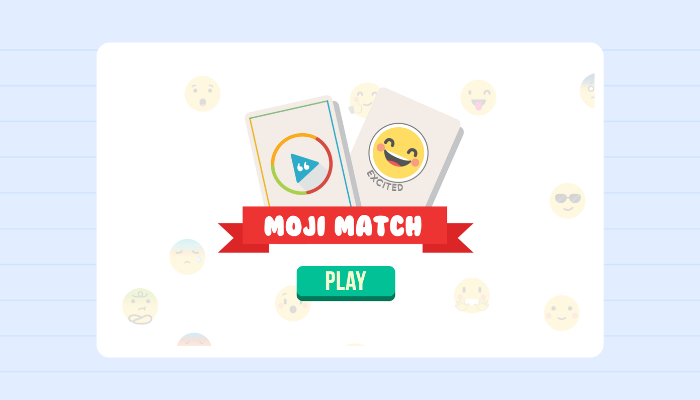
Build-a-Moji is an emotional recognition game that offers this type of interactive practice. Students actively select facial features to represent a specific emotion, creating a visual representation that reinforces understanding.
Why Games Are Effective for Teaching Emotion Recognition
Emotion recognition can feel abstract for many students. Games make the skill more tangible by providing clear tasks and immediate feedback.
Interactive visual activities strengthen understanding of facial cues. When students build an expression themselves, they must think carefully about which features match the target emotion.
A guessing format also reinforces accuracy. As peers analyze the constructed face and attempt to identify the emotion, they practice looking closely and using precise vocabulary.
Because the format is interactive, students remain engaged while receiving repeated exposure to emotion words and expressions.
How This Emotional Recognition Game Builds Emotion Identification Skills
In Build-a-Moji, one student receives a target emotion and selects facial features to construct a matching emoji-style face. The builder must consider how each feature communicates the intended feeling.
Peers then analyze the constructed face and guess the emotion based on visual cues. This step encourages careful observation and discussion about why certain features signal specific feelings.
Optional scoring can add motivation while maintaining focus on the skill. As students rotate roles, they experience both building and identifying emotions, which reinforces understanding from multiple perspectives.
The clear structure allows educators to facilitate meaningful discussion while keeping the activity organized and focused.
Teaching Emotion Recognition With Interactive Games
Emotional recognition requires repeated, focused practice. Students benefit from opportunities to observe expressions closely, use accurate vocabulary, and reflect on how emotions appear in everyday situations.
Interactive activities provide a structured way to reinforce these skills without extensive preparation. When students actively build and analyze expressions, they strengthen both awareness and communication.
Build-a-Moji offers a practical way to support emotional recognition instruction in elementary classrooms.
Play Build-a-Moji to give students meaningful practice identifying and building facial expressions.