Intrinsic vs. Extrinsic Motivation in the Classroom: What It Means for Student Behavior


Most educators are familiar with the debate around intrinsic vs extrinsic motivation.
Intrinsic motivation comes from within. Extrinsic motivation comes from outside. The distinction sounds simple. But in practice, it sits at the center of one of the most common tensions in classroom behavior support.
When we rely on rewards to drive expected behavior, are we actually building the skills students need, or are we just making short-term compliance easier to manage? This is not a case against structure or positive reinforcement.
Reward systems are common in schools for a reason. They can be effective tools for establishing routines and motivating students in the moment. But motivation alone does not teach a skill. And for many students, the absence of a reward is also the absence of the behavior.
Understanding how intrinsic and extrinsic motivation work in the classroom and what they cannot do on their own is a starting point for building something more lasting.
Free Resources Mentioned in This Article
If you are looking for practical tools to support skill-based behavior instruction in the classroom, explore the resources below.
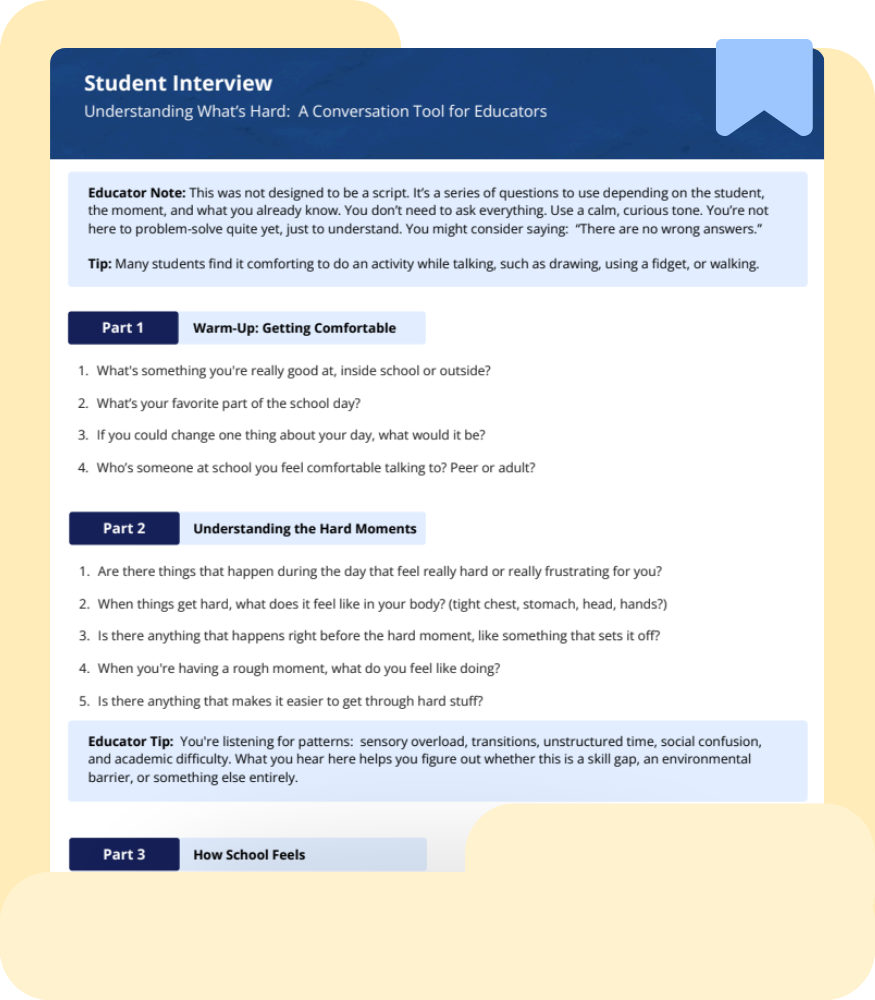
Free Download: Positive Behavior Practices + Student Interview Tool Two practical resources for educators ready to move beyond reward systems.
The Positive Behavior Practices guide offers responsibility-based, relationship-based, and autonomy-based alternatives to prize boxes. The Student Interview tool gives educators a structured way to understand what is actually hard for a student before deciding on a response.
What Is Intrinsic vs. Extrinsic Motivation? A Quick Classroom Definition
Motivation is what drives behavior. It is the reason a student raises their hand, completes an assignment, or chooses to work through something difficult instead of shutting down.
Psychologists have long distinguished between two types of motivation. Intrinsic motivation is internal. A student is intrinsically motivated when the activity itself is the reward. Curiosity, interest, or a sense of accomplishment drives the behavior. Extrinsic motivation is external. A student is extrinsically motivated when something outside the activity drives the behavior. A grade, a token, a prize, or praise from an adult.
Both types exist in every classroom, and the intrinsic vs extrinsic motivation question is not really about which one is better. The question is what happens when extrinsic motivation becomes the primary driver of behavior, and whether that approach is building the skills students need to navigate situations where no external reward is present.
For educators working in PBIS frameworks or using classroom reward systems, this distinction matters. Incentive structures can be useful starting points, but they work best when paired with explicit skill instruction. Social skills activities that build self-regulation, problem-solving, and emotional recognition give students something to draw on long after the prize box is gone.
How Extrinsic Motivation Shows Up in Schools
Most educators have seen extrinsic motivation in action. Token economies, prize boxes, behavior charts, sticker systems, and point systems are common across elementary and middle school classrooms. PBIS reward systems formalize this at the school-wide level, giving students points or tickets for meeting behavioral expectations that can be exchanged for prizes, privileges, or recognition.
These systems are not inherently problematic. They are familiar, structured, and often effective at establishing routines and getting buy-in from students who need a clear and immediate reason to engage. For some students, an external reward is a meaningful bridge to a behavior they have not yet internalized.
The concern is not that PBIS rewards ideas exist. The concern is what happens when the reward becomes the only reason a student meets an expectation. When the system is the strategy, and a student has not developed the underlying skill, the behavior tends to disappear when the reward does.
Educators looking for PBIS rewards examples often find lists of prizes and incentives. What is harder to find is guidance on what to teach alongside those systems so that students build genuine competence, not just respond to external pressure. That is where structured skill instruction comes in.
Where Extrinsic Motivation Falls Short
Research on motivation consistently shows that heavy reliance on extrinsic rewards can actually undermine intrinsic motivation over time. When students learn that effort is something they do for a reward, the absence of a reward becomes a reason not to try. This is sometimes called the overjustification effect, and it shows up in classrooms more often than educators realize.
But there is a layer beneath the motivational conversation that often goes unaddressed. Many students who struggle to meet behavioral expectations are not unmotivated. They are missing key skills. The behavior we are trying to reward into existence is one they have not yet been taught. Offering a prize for a skill a student does not have is a little like grading a student on content they have never been taught and calling it an incentive.
Structured practice gives students the explicit instruction they need to actually build the skills reward systems assume they already have.
Behavior Is Communication: What Students Are Really Telling Us
When a student refuses to start their work or melts down during a transition, the instinct is often to ask how to stop the behavior. A more useful question is: what is the behavior communicating?
All behavior is a form of communication. When students do not have the language, skills, or self-regulation to express what they need, big behaviors fills that gap. A student who slams the door is not making a choice to be disruptive. A student who shuts down during independent work is not being lazy. These are students telling us, in the only way available to them at that moment, that something is not working.
This reframe matters because it changes the intervention. If behavior is a skill deficit, the response is instruction. If behavior is communication, the response is curiosity. What is this student missing? What have they not yet been taught? What lagging skills in self-regulation, emotional recognition, or problem-solving are showing up as behavioral challenges?
Ross Greene’s collaborative problem-solving model, outlined in his book, The Explosive Child, offers a practical framework for identifying those lagging skills and addressing them directly rather than managing behavior from the outside in.
Understanding behavior as communication is also a foundation for more effective social skills lessons. When educators know what a student is communicating, they can target instruction where it actually needs to go.
Positive Behavior Practices + Student Interview Tool
Two practical resources for educators ready to move beyond reward systems. The Positive Behavior Practices guide offers alternatives to prize boxes built around connection, choice, and growth. The Student Interview tool gives educators a structured way to understand what is actually hard for a student before deciding on a response.
What Skill-Based Motivation Looks Like in the Classroom
Shifting from reward-dependent systems to skill-based instruction does not mean removing structure. It means changing what the structure is designed to do. Instead of managing behavior from the outside, the goal is to build the internal capacity students need to manage it themselves.
In practice, this looks like three things.
The first is modeling. Students need to see skills demonstrated explicitly, not just expected. This means showing what self-regulation looks like in a moment of frustration, what problem-solving looks like when a plan falls apart, and what asking for help looks like when something feels too hard. Video modeling, role play, and teacher think-alouds are all effective tools for making these skills explicit.
The second is collaborative problem solving. When a student is struggling behaviorally, sitting down with them to identify what is getting in the way and what might help is more effective than consequences or incentives. It builds trust, develops self-awareness, and gives students language for their own experience. The CPS materials from Lives in the Balance are a strong starting point for educators who want to bring this approach into their practice.
The third is structured reflection when the student is regulated. Students need opportunities to practice identifying their own emotional states, recognizing what triggered a response, and thinking through what they could do differently.
Social skills worksheets designed around self-regulation and problem-solving give students a consistent framework for that kind of reflection. Social skills games can also make that practice feel less clinical and more engaging, particularly for students who disengage from traditional instruction formats.
Can You Use PBIS Rewards and Still Teach Skills?
Yes. And for most educators, that is the realistic starting point.
Abandoning a school-wide PBIS system overnight is not practical, and it is not necessary. The goal is not to eliminate reward structures but to make sure they are not doing all the heavy lifting. A prize box is not the problem. A prize box that substitutes for skill instruction is.
The most effective approach treats extrinsic rewards as a scaffold, not a destination. In the early stages of building a new behavior, external motivation can help a student engage long enough to begin developing competence. The key is pairing that reward with explicit instruction so that the skill develops alongside the incentive, rather than in place of it.
For educators working within PBIS frameworks, this means asking a different set of questions alongside the reward system. Not just whether a student earned their points, but whether they understand why the expected behavior matters, whether they have been taught the skill the expectation requires, and whether they have strategies to draw on when things get hard.
PBIS rewards examples and incentive menus have their place. But the students who struggle most with behavioral expectations are usually the ones for whom the reward alone is not enough. Those are the students who need skill-building most, and who benefit most when instruction and incentives work together.
How to Start Shifting Away From Reward-Dependent Systems
The shift from extrinsic rewards to skill-based instruction does not have to happen all at once. For most educators, it starts with a small change in how they interpret and respond to behavior.
A few places to begin.
Start with curiosity instead of consequences. When a student struggles behaviorally, ask what skill might be missing before deciding on a response. This does not mean ignoring the behavior. It means adding a layer of inquiry that makes the intervention more targeted and more effective over time.
Name the skill explicitly. If the expectation is that students work independently for twenty minutes, make sure that skill has been taught directly. What does it look like to manage frustration when work feels hard? What is the student supposed to do when they finish early? What are they supposed to do when they do not understand something? These are teachable skills, not character traits.
Build reflection into the routine. Short, consistent opportunities for students to check in on their own emotional state and problem-solving process build the self-awareness that reward systems cannot. This does not require a full lesson every day. It can be a two-minute check-in, a short written reflection, or a structured conversation.
Use the support that exists. There is a strong body of social skills interventions research and classroom-ready resources that make this work more manageable. Educators do not have to build skill-based instruction from scratch.
Why This Shift Matters for Long-Term Student Outcomes
Reward systems can change behavior in the moment. Skill instruction changes what a student is capable of doing on their own.
That distinction matters most when students leave the environments where the reward system exists. In the hallway, on the bus, at home, in a new classroom with a different teacher and a different set of expectations, the prize box does not always come with them. The skills do.
Students who have been taught to recognize their own emotional states, ask for help when they need it, work through conflict with peers, and regulate themselves in frustrating situations are better equipped across every setting they encounter. That is the outcome worth building toward.
This Is Not About Throwing Out the Prize Box
Reward systems are not the enemy. For a lot of students, they are a meaningful part of how a classroom feels structured and predictable. The goal here is not to dismantle what is working. It is to make sure something else is working alongside it.
When students have explicit instruction in the skills behind expected behavior, reward systems become more effective, not less. The incentive reinforces something real. The student is not just complying for a prize. They are practicing a skill they are actually developing.
The intrinsic vs extrinsic motivation conversation is a starting point for your teams, not a destination. This is a shift worth making. Not a policy change, not a full curriculum overhaul, but a gradual reorientation toward asking what students need to learn, not just what they need to do. Start with one student, one lagging skill, one conversation.